


Fragrance held a profound significance in the ancient Mediterranean world. Precious oils and aromatic preparations were intimately connected to rituals of beauty, bathing, religion, and burial, often preserved in vessels as carefully considered as their contents.
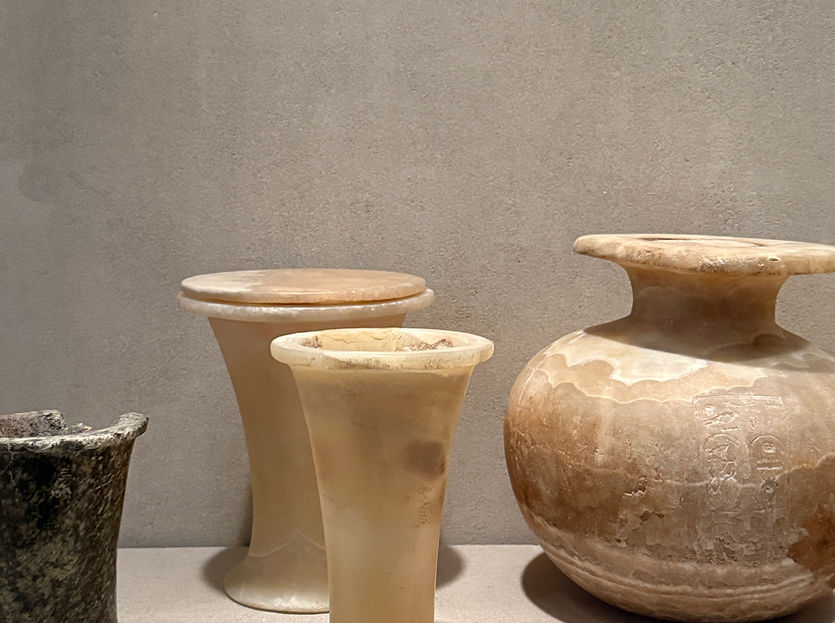
Among the most distinctive were the alabastro, slender perfume containers whose origins can be traced to ancient Egypt and whose forms were later adopted and reinterpreted by Greek and Roman civilizations.
Characterized by elongated bodies, narrow necks, and softly rounded contours, these vessels represented an early convergence of sculpture and utility. Their proportions were determined by the practical need to preserve and dispense valuable scented oils, yet their elegant silhouettes transformed everyday objects into expressions of artistry and refinement.

ALABASTRO
PERFUME
VESSELS
Ancient Egypt (from the Old Kingdom and Middle Kingdom through the New Kingdom, such as King Tutankhamun's 14th-century BCE tomb artifacts), Ancient Greece and Etruria (Archaic and Classical periods, 6th–4th century BCE), through the 19th to mid-20th centuries (Victorian and vintage Italian alabaster/art glass pieces).

The Lucca Chandelier
by Orphan Work
The history of the alabaster is closely connected to the material from which many of its earliest examples were carved. Egyptian alabaster was prized for its delicate veining, luminous appearance, and remarkable ability to transmit light through thinly worked stone.

Egyptian artisans developed sophisticated techniques for shaping and hollowing stone vessels, carefully reducing substantial blocks of material into refined, functional forms. The process demanded an intimate understanding of the stone's natural characteristics, as each vessel revealed variations in color, translucency, and mineral patterning. What emerged was an object defined as much by the inherent beauty of its material as by the precision of the artisan's hand.
As alabaster spread throughout the Mediterranean, its form evolved across cultures and centuries. This continuity speaks to the enduring intelligence of the original design.
More than two thousand years later, ancient alabaster perfume vessels remain compelling studies in proportion, material, and craftsmanship. Their beauty lies in the restraint of their forms, where the subtle transition between a slender neck and rounded body creates a sculptural presence without unnecessary embellishment.
When carved from translucent stone, the natural veining and variations of the material become an integral part of the composition, allowing each vessel to possess a character entirely its own.

LUCCA
Inspired by ancient alabaster perfume vessels, the Lucca is a result of millions of years of natural formation in Northern Italy. Skillfully turned from solid stone by our maestri, the elongated alabaster shades hang from straight or draped, handmade brass chain links of varied length. The distinct pattern on each light fixture is shaped by the inherent qualities of the stone itself, brought to life through the expert use of traditional stone-carving techniques with roots dating back to 1895. The pattern is record of its 6 million year journey to you. Impossible to predict.