
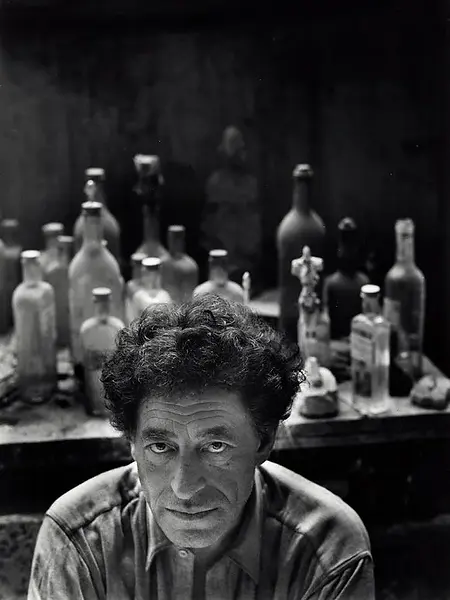

Born in Switzerland and working for much of his life in Paris, Giacometti became one of the most influential sculptors of the twentieth century.
The lesser-known creations reveal another dimension of his practice, where the language of sculpture entered the intimate setting of the domestic interior.
During the 1930s, recognizing the sculptural potential of the artist's unconventional forms, Giacometti began collaborating with the celebrated Parisian interior designer Jean-Michel Frank, whose interiors were distinguished by architectural restraint, exceptional materials, and an understated approach to luxury.

ALBERTO
GIACOMETTI
Born: October 10, 1901, Borgonovo, Bregaglia, Switzerland
Died: January 11, 1966 (age 64 years), Chur, Switzerland
Periods: Modern art, Surrealism, Cubism, Expressionism
Influenced by: Cubism and Surrealism

The Ambra Sconce.
by Orphan Work
The relationship between Alberto Giacometti and Jean-Michel Frank was one of the most compelling collaborations between fine art and interior design in twentieth-century Paris.
Working in plaster, visible traces of hand modeling introduced an unexpected intimacy to otherwise restrained silhouettes. Their subtle imperfections became an essential part of the composition, catching light and creating variations of shadow across the material.
Through this balance, Giacometti transformed familiar domestic objects into compositions that invited the same contemplation as his independent sculptures.

His collaboration with Jean-Michel Frank helped establish a distinctive relationship between sculpture, the hand, and the modern interior.
Designed for Frank in 1933, Giacometti’s "Égyptienne lamp" draws inspiration from the extraordinary alabaster oil lamps discovered in the tomb of Tutankhamun in 1922.
His fascination with ancient Egyptian art began early in his career. In a letter to his parents from Rome in 1920, he expressed that Egyptian sculpture possessed a mastery of proportion and technique unmatched by later civilizations.
This appreciation for ancient forms became central to his exploration of the relationship between sculpture and domestic objects. In reinterpreting the Egyptian oil lamp, Giacometti removed its elaborate side supports and carved floral ornamentation, reducing the composition to its most essential elements. The result was a remarkably modern sculptural form, where classical inspiration became a testament to his enduring fascination with ancient craftsmanship.

